Summary
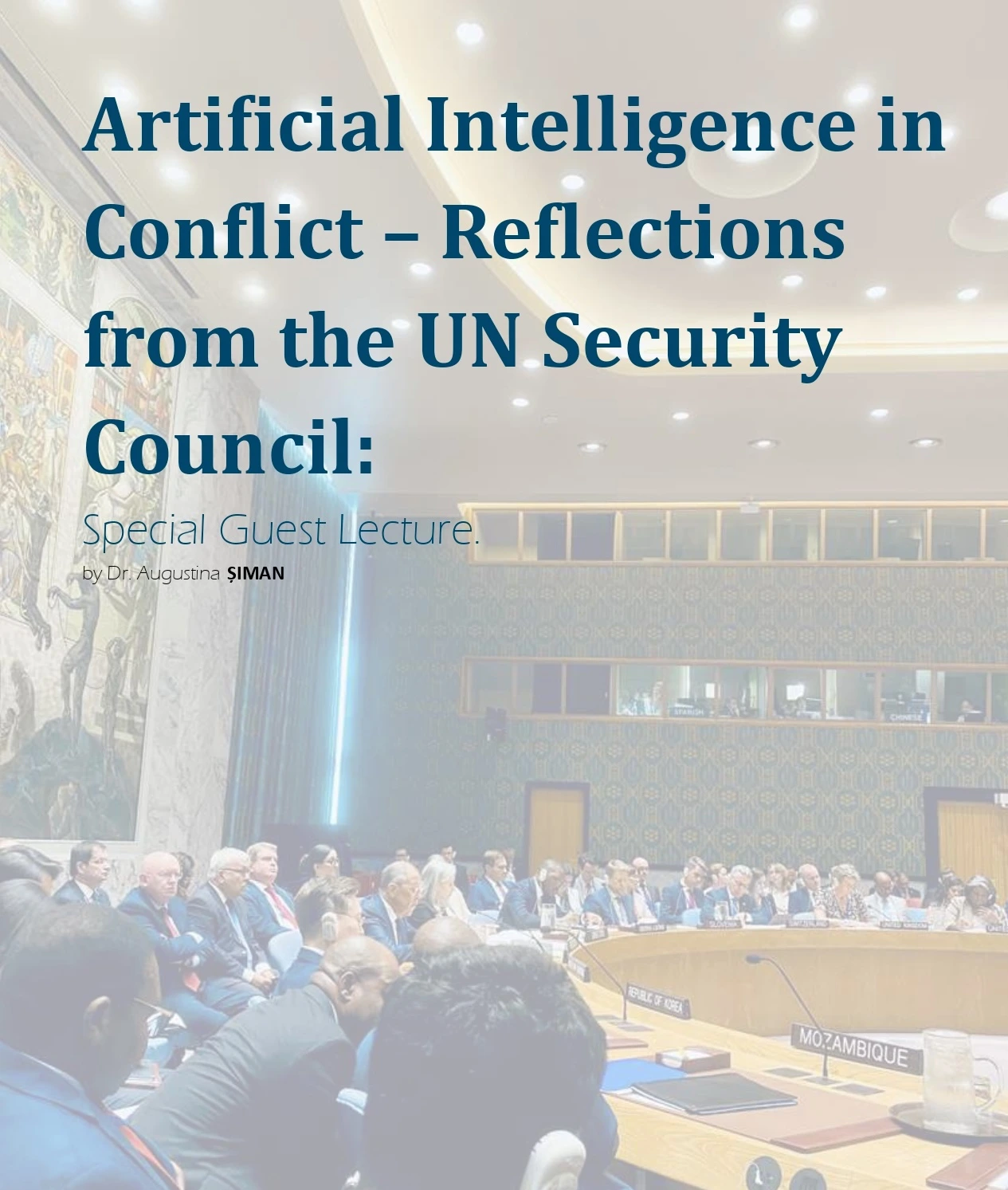
On 23 April 2026, I had the honor to deliver an in-person Special Guest Lecture entitled “Artificial Intelligence in Conflict - Reflections from the United Nations Security Council” to undergraduate students, upon the invitation of the Department of International and European Law, of the Law Faculty, of Moldova State University. The lecture was designed to bridge theory and practice, offering students a rare insight into how the events they follow in global news headlines are translated into diplomatic discussions within the United Nations Security Council and the United Nations General Assembly, and how these discussions can gradually evolve into United Nations policies, normative frameworks, and potentially even new international legal instruments. Drawing on my professional experience at the United Nations, the lecture explored both the legal and ethical dimensions of the use of artificial intelligence in armed conflict. It elucidated the diverse and often divergent positions of UN Member States, while also offering expert-level reflections on emerging challenges - ranging from accountability and human control to the increasing role of private actors in shaping military AI capabilities. The session concluded with a structured discussion addressing key frequently asked questions, enabling students to engage critically with one of the most rapidly evolving and consequential issues in contemporary international law and global security.
Key points
- The use of AI in conflict is no longer emerging, it is a frequent reality: One of the most striking findings of the lecture is the speed at which artificial intelligence has moved from innovation to operational deployment in conflict settings. The fact that the United Nations Security Council first formally addressed artificial intelligence only in July 2023, followed shortly thereafter by the United Nations General Assembly in 2024, demonstrates that by that point AI had already become sufficiently widespread to require attention at the highest level of international peace and security governance. This timeline therefore reflects a sobering reality that technology is not waiting for law or diplomacy to catch up, it is already shaping the battlefield.
- The United Nations Member States have rapidly elevated AI to a matter of international peace and security: What began as a technological issue has now been firmly reframed as an international peace and security concern. Security Council debates and events between 2023 and 2025, including high-level briefings and open debates, have consistently highlighted that AI can act as a force multiplier in military operation, can lower the threshold for the use of force, and can compress decision-making time, reducing opportunities for diplomacy and de-escalation. At the same time, experts and UN officials have repeatedly warned that the weaponization of AI may pose existential risks, particularly in scenarios involving loss of human control or misuse by state and non-state actors.
- It is important to underline that there is currently no UN treaty that specifically regulates artificial intelligence in armed conflict. Instead, international law regulates permitted and prohibited uses of force, and is applied to include those involving AI-enabled military technologies, through International Humanitarian Law (IHL) and related International Human Rights Law (IHRL) protections. These frameworks establish clear legal obligations, including: (I) the principle of distinction, requiring differentiation between civilians and combatants and prohibiting direct attacks on civilians and civilian objects; (II) proportionality, prohibiting excessive civilian harm in relation to the anticipated military advantage; (III) necessity, limiting the use of force to what is required to achieve a legitimate military objective; and, for instance, the right to privacy, as protected under the 1966 International Covenant on Civil and Political Rights.
- The private sector is transforming warfare: A defining feature of this technological advancement is that States don’t fully control the means of innovation. As highlighted throughout the lecture, AI infrastructure, models, and capabilities are largely developed by private companies - and Governments increasingly rely on these actors for military modernization and operational capacity, while falling behind to impose limitations through national regulations and, at times, choosing to not impose national regulations in order to not fall behind in the AI arms race. This closed circle creates casualties and loss of human life in conflictcs across regions, and it can be broken only by States adopting normative limitations in the field of AI.
- Security Council debates can shape a future treaty or set of principles, indirectly: The United Nations Security Council’s debates play a crucial role in setting the global agenda, defining acceptable norms, and creating political pressure and expectations. Over time, these discussions can contribute to the development of customary international law, and the emergence of a treaty, or of a norm (included in a treaty), or of a set of guiding principles, on the use of AI during military conflicts.
- Lastly, regarding legal accountability. Think about it this way: Imagine the look in the eye of our ancestors, in prehistoric times, the first time they shot their arrow with a sharp stone point, and saw it flying in the sky at what seamed for them to be a great height, a great speed, and traversing a great distance, piercing the heart of another human from another tribe – the enemy. When witnessing how drones and robots act in combat, we share the same sentiment of fascination with our prehistorical ancestors when they witnessed how their hunting stone points killed. I also invite you to think about the Industrial Revolution, which transformed military technology and production methods, with machine guns being produced and used during the First World War. Machine guns, particularly the Maxim Gun, introduced in the late 19th century, transformed the battlefield dynamics during World War I, with the ability to fire up to 600 rounds per minute. What does the arrow with the sharp stone point, the Maxim Gun, and the military drones all have in common? They were all created by humans. They exist because of humans, and they work in a certain way because of human design. Arrows, guns, drones, robots, AI software, are all in the end tools with which, in international armed conflicts settings, humans (leaders, military commanders, soldiers, etc.), and states, commit genocide, crimes against humanity, and a variety of other crimes under international criminal law and the framework of the Rome Statute, as well as violations of international humanitarian law and international human rights law. The arrow with a sharp stone point is not to blame.