Summary
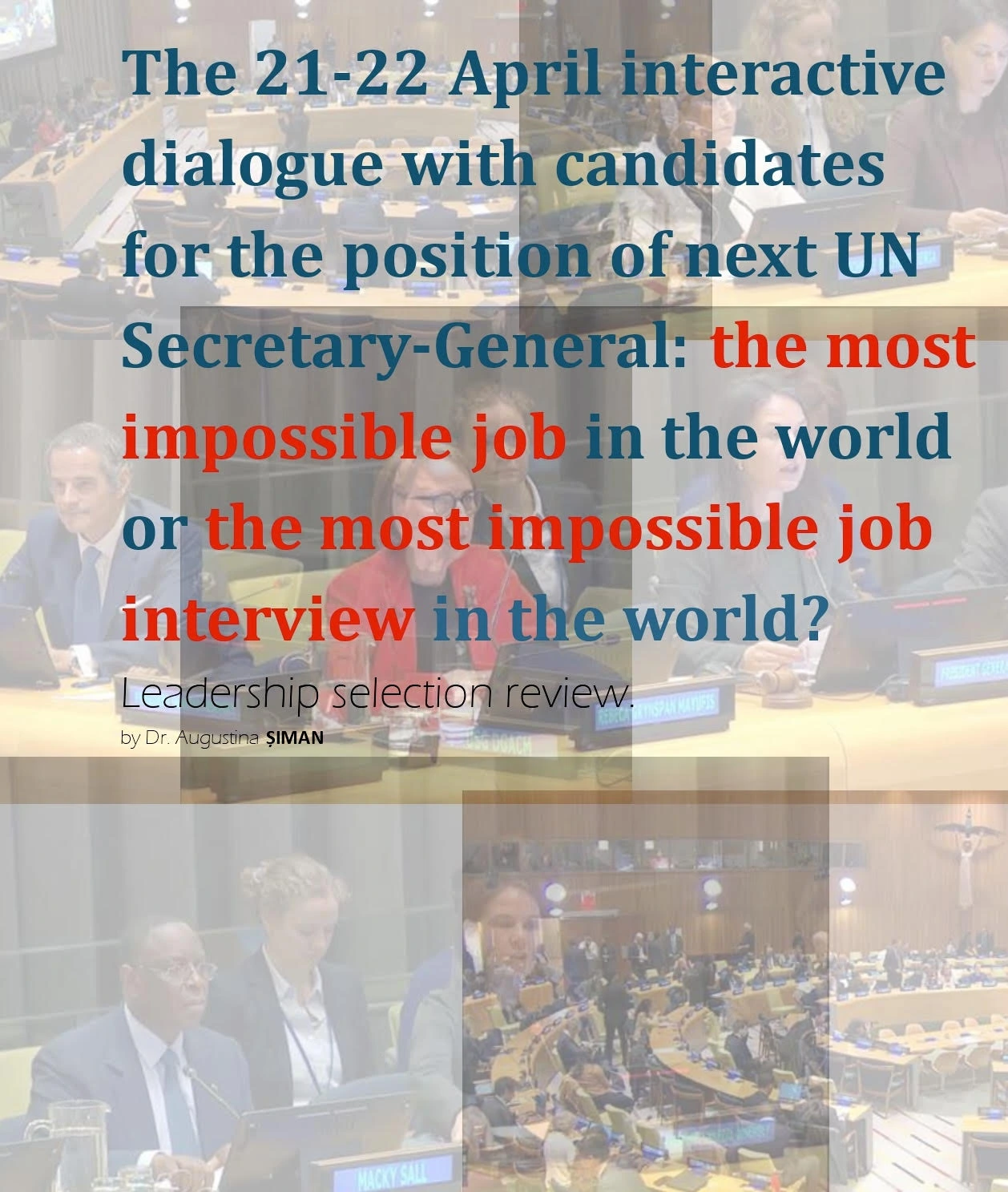
This timely leadership selection review examines the 21–22 April 2026 informal interactive dialogues between the UN General Assembly and candidates for the position of next UN Secretary-General. It explains that this year’s process further enhanced the transparency and inclusivity efforts by introducing 3-hour segments (in comparison to the 2-hour ones in 2016) and inviting civil society organizations to ask questions on an equal footing with states. This, although having the best intentions at heart, translated into extraordinary demands on candidates - with hundreds of complex and politically sensitive questions asked under strict time limits. As a result, the dialogues often resembled the world’s most difficult job interview rather than a focused assessment of leadership abilities and deep understanding of the three pillars of the United Nations (Peace and Security, Development, Human Rights). The review also highlights that the decisive stage of the selection process still lies within the Security Council, where private negotiations, straw polls, and the need to avoid a veto shape the final outcome. In its conclusions the review lists and explains several carefully elaborated recommendations through which the practice of interactive dialogues can be improved, with the purpose of transforming the “most impossible job interview in the world” for candidates into the “most fulfilling job interview in the world” for the United Nations.
Key points
- The 2016 process became even more inclusive and demanding than the previous 2016 process: Compared with the 2016 informal interactive dialogues, the 2026 dialogues were expanded from two-hour sessions to three-hour sessions, while civil society participation was placed on the same footing as Member States rather than being heard only if time permitted. This strengthened transparency and inclusivity, but also significantly increased the intensity of the process for candidates.
- Candidates faced an exceptionally high volume of questions: During the four dialogues held on 21–22 April 2026, candidates received approximately 100 to 200 questions per interactive dialogue, depending on the number of interventions on behalf of UN member states and civil society organizations. In one cited example, a candidate received around 71 questions from 30 delegations, excluding the questions from civil society questions.
- Public transparency and inclusivity coexists with private political decision-making: Although the General Assembly dialogues are public and available on UN webcast, the decisive phase of the process remains within the Security Council through closed-door meetings, bilateral negotiations, straw polls, and the efforts to avoid a veto from a Permanent Member vis-a-vis the resolution recommending to the General Assembly a single candidate for appointment as the next UN Secretary-General.
- Practical reforms could improve future dialogues: The paper proposes several easy-to-implement improvements, such as: introducing a 15-minute break during the informal interactive dialogue, limiting each intervention to one principal question and one follow-up question, publishing standardized core questions for all candidates to which they can submit publically available answers - therefore creating a genuine fair comparability basis between candidates and off load the interactive dialogues, leaving more space within them for inquiries on more specific matters.